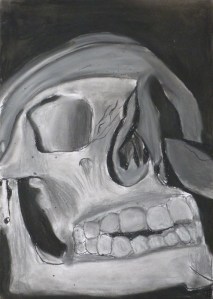
Artwork: Enrique Cropper
Such was the immediacy of Patricia’s internal dialogue with her dead husband, there were even times of the day when a semblance of normality appeared in relation to his physical absence. “Besides,” Patricia had often jibed, “he spent half his life chained to that ERA desk.”
Yet, for all her strength, all her uplifting spiritual imaginings, and all her attempts to persuade herself that things at home were ‘more or less normal’, Patricia’s children soon learnt to tell when Patricia was having ‘one of her bad days’. The signs were varied but recognisable: an odd, distracted air during a conversation; a brief bowing of the head at an unexpected moment in the day; or a gentle sob from the bathroom when Patricia put herself out of sight.
On these occasions, though they could see it coming, they were powerless to prevent Patricia from ebbing away into a morose state of despair, when Patricia would slowly find herself engulfed in loneliness, telling herself, as she spiralled downwards, that George was no longer there and that she was a fool to even try imagining that they would ever be together again. In such a condition, a pattern would repeat. A darkness would envelope Patricia and she would shut herself off from contact with anyone else than her closest family, simply chuntering that “It’s alright” and “Don’t you worry about me”.
Continue reading →






 writingbrussels