
“OK George! We got the picture!” jibed André, in response to George’s graphic description of the state-of-the-art of administration 30 years before. “But remember! Despite the old tech, you did manage to make the policy coup of introducing the Euro! And at least you didn’t have to do it all with quill pens and parchment!”
Without realizing it, George’s colleagues had been rash to underestimate how much George had reflected over the years on Parkinson’s law and his scientific approach to administration. George had even devised his own calculation method for such matters. He always found a mathematical expression helped discipline his thinking. To avoid the conversation going in all directions, George was now starting to think that it would be a good idea to use the equation to guide his argumentation.
“Ha! Ha!” George came back, chuckling in two breaths to show the others he was keen to share more. “Precisely. Quill pens and parchment. Let’s have a closer look at what I like to call the ‘computer effect’ in the ERA over the last 30 years.”
“What, are you going to show us? That the increase in workload has been completely compensated by an equivalent increase in time efficiency, brought on by computers?”
“No, no, I wouldn’t go that far,” replied George, feeling encouraged now by the engagement his colleagues were showing. “You know yourselves that the potential time saved by a machine is one thing, and the skill level of the people who employ that machine properly, is another,” he said gesturing with one hand, then the other.
“But I’d say that using a computer for all the classic administrative tasks, like writing a letter or laying down a regulation, takes at least a fifth of the time it took 30 years ago.”
“Yeah, talk about skill level,” interrupted Jernej with a big smile on his face. “I was watching some old fogey getting completely lost on his PC the other day.”
George raised an eyebrow at the words ‘old fogey’ but didn’t let it put Jernej off his argument.
“This old guy obviously wasn’t a go-faster type. I could see he didn’t know any of the shortcuts in Microsoft 365,” continued Jernej, throwing his head back with a sneer. “It just shows you. IT skill levels in the ERA are all over the place!”
“You’re quite right, Jernej. The variability in skill levels in general is high at any time, in a large administration. The only problem here in the ERA is that few of us bother to address skill acquisition and so we remain ignorant of what I’m sure Parkinson would call our ‘Coefficient of smartness’”.
“Coefficient of smartness?” quipped André. “What now George? I’m afraid I’m starting to lose track.”
At the risk of appearing pedantic, George decided it was time to present his thoughts more deliberately, and reached into his jacket pocket for a pen and paper.
“OK, let me put it more simply,” he declared and began to scribble down an equation.
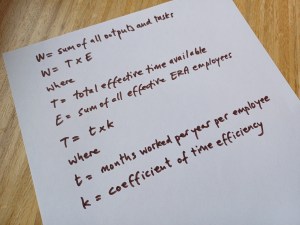
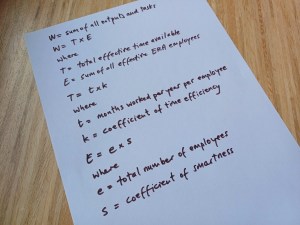
“Let’s call ‘capital W’ ‘Work’, that is, the sum of all the outputs and tasks we make in a given year, y. And ‘capital W’ is derived by multiplying the total effective time available, let’s call it ‘capital T’, multiplied by those who do the tasks, that’s us, the employees, represented as the sum of all the effective employees, functionaries and other staff, in the ERA, ‘capital E’, here.”
George wrote down the simple version of the equation.

André, Jernej and Konrad glanced at each other, agreeing through the look on their faces that they had never seen George quite like this before. He certainly seemed ‘in the groove” on this one. So taken aback did they seem with George’s enthusiasm that George felt at total liberty to continue.
“Now ‘capital T’, as the total effective time available, in person-months per year, is made up from the number of months worked per year, ‘little t’, which for the sake of simplicity, let’s assume, has not changed much over the last 30 years in the ERA. Let’s say it’s seven months. Then we multiply that by the so-called ‘Coefficient of time efficiency’, ‘little k’.” George continued with his professorial scribblings.
“Uh? One moment,” said Konrad, the intern, hesitantly. “I understood the Coefficient of time efficiency but where has the Coefficient of smartness gone?” he asked.
“Wait. Yes. Here,” said George, pleased that Konrad had been following him, as he pointed at the ‘capital E’ he had written earlier. “’Capital E’ represents the total number of employees and ‘little s’ is the Coefficient of smartness. Take it as a measure of how smart the workforce is at any moment. See, here, ‘capital E’ is ‘little e’, the total number of employees, multiplied by ‘little s’ the Coefficient of smartness,” George kept explaining, as he extended his equation further.
Having drawn all the focus of the conversation to his equation, George had not noticed that colleague Jernej had already slipped away from the table. And, by now, André was also looking a bit sheepishly towards him.
“Oh! I’ve got to go!” André suddenly announced. “I have a meeting at 9.30!”
André grabbed his mug and left the table, leaving George with only Konrad to talk to.
“When you gotta go, you gotta go,” commented George to André, as he turned to Konrad.
“Oh well,” said George whimsically to Konrad, “They’re missing the best bit: solving the equation,” he chimed, giving the intern a quick wink.
[to be continued]




 writingbrussels