Image courtesy of sarahschlitz.be
It took George some time, after his arrival in the EU Regulatory Authority, to put enough space between himself and the most unsettling aspects of his first six months in the organisation.
“The administrative equivalent of a raw army recruit being shoved by the drill sergeant under a freezing cold shower,” commented George, with a wry smile, as he quaffed his glass of port at his 10th Anniversary Reunion of graduates from King’s College.
“It must be such a wheeze with all those brilliant Eurocrats,” quipped Clarkson, one of his cruder former college mates.
“All that ducking and weaving between the wants and why-fores of the member countries!”
George had often noted that, in the British context, there was no strict correlation between level of formal education and an understanding of the role of the European civil service in policymaking.
At least Clarkson wasn’t showing the typical scorn so many other of his compatriots did: maybe it was the heart-warming effect of the vintage port that was taking the edge of his sarcasm.
“Don’t knock it, Clarkson! If it wasn’t for Europe, you wouldn’t have your glass full of this luscious stuff!” George bantered back, raising his glass and tipping back the last swig.
“Wheeze is not exactly how I would describe it,” George was thinking to himself.
Rough start. Roller coaster. Wild, were the words that came to mind.
Over the years, George often reflected on his hyper-sensitivity to the bureaucratic harshness of the ERA in his first months in the organisation and had concluded that his uneasiness with the impersonal structures of the administrative environment was just a result of his own naivety and inexperience of politics.
After all, what was so disconcerting about being addressed as “Monsieur Gardner?”
Why be so alarmed by the question “Vous êtes de quelle nationalité?”
And how could ignorance about the different meanings of the words ‘Eire’, ‘Southern Ireland,’ ‘Northern Ireland’ and ‘The Six Counties’ and, as George’s Irish Director put it, “The correct term for describing the Member States located the farthest west in Europe – Ireland” cause so much discomfort?
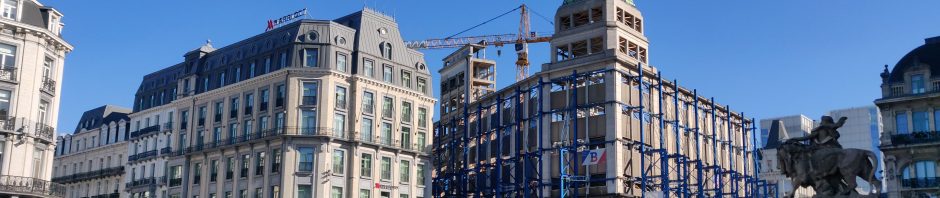
The absence of Patricia, who had stayed with the kids in England for the first nine weeks of his taking up the job in Brussels, had not helped. Luckily Samantha, their little daughter, recovered without complications after a nasty dose of chickenpox. George was a home-loving type, and the bare walls of his room at the Hotel Manhattan on the Boulevard Adolph Max, which he had stayed in before he found an apartment suitable for the entire family, had left him particularly susceptible to the smallest of contretemps he encountered in his first months at the ERA.
George’s main problem hadn’t been those few minor disturbances. He was used to the college staff at King’s addressing him as “Mister Gardner” or always adding “Sir” at the end of their sentences. George had grown to see such things as residual English deference, which had been more or less on its way out in Britain since the 1960s.
“But the Frenchified formality of the European civil service,” George had pondered at the time, “with its Monsieur Ceci and Madame Celà. It seems so much like it’s being used to put everybody in their place”.
On the question of nationalité, George surprised himself with the answer he developed over his origins and more often than not answered “J’ai un passeport britannique.” The indirectness of his reply belied the feeling, which had grown on him since his university days, that being British wasn’t so much a nationality as a construct, from the Age of Empire, and that he personally identified with being English, more than anything else.
As for the sharpness of tone of his Irish colleagues on the right name for Ireland, George quickly realised that he had never met a real Irishman before: that is, an Irishman from Ireland, let alone one of a political persuasion who’d also been taught by the Christian Brothers every day of his life about the events leading up to the year 1922.
Until he joined the ERA George had never thought too much about the Irish friends he been to school, played football, danced at parties and tripped off to university with. Even though they had settled in England generations ago, they still spoke with a lilt and still seemed Irish to George.
On reflection, before coming to the ERA, George had thought the only difference between himself and his Irish friend in England was the order in which jokes were told that began with the phrase “There was an Englishman, a Scotsman, a Welshman and an Irishman”.
It was after a chance conversation with a more affable Irish colleague he met at a newcomer’s reception in his first week, that George became more fully aware of the idiosyncrasies of Irish and British geography; the history and rules for selection of such disparate institutions as the Irish and Northern Irish national football and rugby teams; and how it came about that Irishmen formed a Guards regiment of the Queen’s very own Household. And all that had been going on since the first Anglo-Norman invasion of Ireland in the 12th century.
“I see,” thought George to himself, taking his witlessness as a first warning: “Watch what you say, mate. You’re in the ERA now.”
+++
But still, a few lessons from colleagues on Irish history weren’t enough on their own for George to come to the view that starting work at the ERA was a ‘rough ride.’ A chat with Lundqvist, the old timer, in the train from La Hulpe a couple of weeks later, had also contributed.
Lundqvist was a tall, wiry, silver haired Dane, with a steady manner and a melancholic look in his eyes. He seemed to take pity on George, though Lundqvist did have a reputation, George later learned, for accosting new officials and probing them with questions.
But George didn’t mind Lundqvist’s inquisitions at all. In fact, George never forgot the wise reflections the old man revealed through his questions. He had been the first to give him the ‘Heads up’ on working in the ERA.
“How old are you? Lundqvist had begun.
“I just turned 30.”
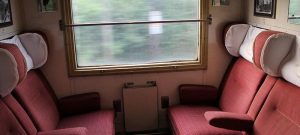
“Have you worked before you came to the ERA?” continued Lundqvist without pause, as the two of them sat back opposite each other in the faded, pink-velvet seats of the first-class carriage, which, Lundqvist had commented earlier, were “Well worth paying that little bit more for.”
“Er, yes,” replied George with a slight hesitation, “I worked since I was a kid in my parents’ shop. And after university I got a placement in Goldman Sachs, where I stayed three years before moving to the Bank of England for the last six years, before I passed the concours for the ERA.”
“Married?” came the third interrogation.
“Yes,” said George, without elaborating further.
“Children?”
“One little girl.”
Lundqvist dwelt on George’s replies, his face showing a slim sign of satisfaction.
“This is good,” he asserted, his Danish accent exaggerating the flat cadence of his voice. “A man needs to come to the ERA with coordinates.”
Lundqvist knocked his head back gently, before adding: “The ERA is a place is full of sharp corners, for those who come with little experience of life.”
George remembered straining himself at the time to keep his face straight, while inside the question was screaming out: “What on earth is Lundqvist trying to say?”
“Oh, I’ve seen lots of officials in their twenties come to the ERA,” added Lundqvist, who broke off for a moment.
“And things don’t always go well. The high salary and the power of the position go to the young fellows’ heads,” he continued.
“And the result is not good. Not good at all.”


 writingbrussels