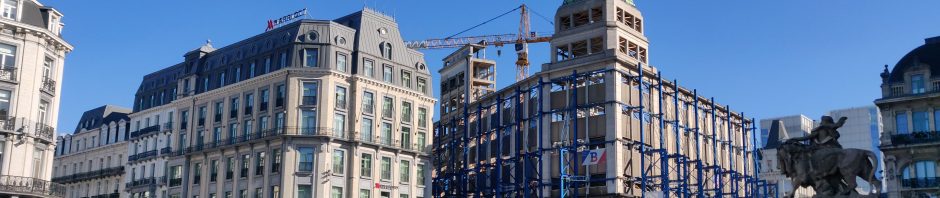

The train journey to Brussels that morning was particularly fruitful. None of George’s occasional, more garrulous, travel companions had joined him in the secluded first-class section. The quiet moment allowed George the chance to mull over his previous night’s trauma.
But how could he square his daytime confidence that AI was just a load of souped-up spinning jennies, with his dreamed perception that the very same machines were about do all the work of the ERA themselves?
George dropped his brief case on his desk and turned round immediately to look for some colleagues to invite to coffee. George was delighted to see Lucija was at her workstation. He was even more pleased that she was ready to take him up on her offer of coffee.
“Sure thing!” she replied gayfully. “I’ll just finish this email, if I may. Meet you downstairs.”
On his way down the corridor, George picked up Konrad, who was unusually early in the office that day. The queue for coffee passed quickly with its customary small talk and they were soon at a table with Lucija’s cappuccino waiting for her.
“There was a sequel to our AI discoveries of yesterday,” George announced, as his main conversation opener.
“Oh, really,” answered Konrad. “Had some further thoughts?” he asked, playing to George’s natural inclination to supply an answer to a question.
“Not so much thoughts, as impressions,” continued George.
Over the years, George had learned in the ERA that a show of feelings was rarely a good thing: it could provoke an unhelpful coldness from a colleague, if he or she was caught by surprise. At best it would be discreetly noted, with an air of professional indifference, and enter into that vague category of professional experience as ‘getting to know one’s colleagues better’. At worst, it opened up a path to ridicule.
But such was the intensity, and apparent relevance, of George’s nocturnal experience, to the serious issue of the future of the ERA, and such were the circumstances of this particular coffee with Konrad and Lucija, before whom George felt he had nothing to lose, that George decided to blurt it out.
“Well, actually,” he began, “I had a nightmare, well, more like a wild dream, that AI software apps had gone crazy and taken over the production of briefings. It was weird!”
Just then Lucija appeared with her characteristic, beaming smile. “Thanks, George. My morning capu, just what I needed!”
“Ah, you’ve just arrived in time,” picked up George. “I was about to describe the terrible dream I had last night.”
Lucija’s face straightened.
“I guess you could call it a rebellion of things. I sent a briefing request to ERA-GPT and ended up being inundated with one briefing version after another, each generated by a different bot, claiming it was the perfect policy information tool!”
“Oh, my dear George,” said Lucija warmly, “it sounds like you’ve been taking too much of your work back home with you again!”
Her words, delivered in her measured and amiable tone of voice, immediately relativised the matter and George was kindly put at ease. George, reassured, carried on with his description.
“The scary part was how each app had its own way of stacking up its set of arguments for the briefing but ended up coming out with the same set of recommendations for action!”
Konrad’s face took on a squint, while Lucija maintained a calm look of circumspection.
“And the whacky thing was that each AI tool got its name from Greek mythology. So, in flew all these briefings into my inbox, till it began to overload, and then I woke up!”
In response to George’s revelations, Konrad and Lucija gently rocked back in their chairs.
“But that makes a lot of sense, George,” remarked Konrad. “After all, we have to face the fact that any AI app will make one big pastiche, from whatever it picks up from the web.”
“Yes,” answered George ruefully, “making briefings stopped being the production of original works of art a long time ago!”
“If you think about it,” enthused Konrad, “in the end, it’s the best that the AI tool – and the functionaries for that matter – can do. Where else would we get our input, if it’s not from the web? And how else can a civil servant be expected to put it all together, if not by some sort of collage?”
Konrad’s well founded allusions to art impressed George. Lucija was prompted to join in. She had always found the tasteless habit of IT developers of their baptising their brainchild with a name from the Greek Pantheon particularly irritating.
“I wouldn’t be surprised if Greek mythology was pillaged once more by the IT developers!” she began. “Especially after the way the ERA began by giving the ugliest registration computer programme you could think the most unlikely name of ‘Adonis’”.
She hesitated, preparing to inject a mild dose of pique in her voice. “So, what may I ask, were the inspirational names, in your dream, for these fancy AI tools?”
[to be continued]


 writingbrussels